Dear ~~first_name~~,
In this issue, you’ll find a new job opportunity (Level B), two new PhD scholarship opportunities, and a variety of recent publications from our members. We’re also pleased to share a recording of Steven Threadgold’s presentation from last Friday’s Social Stratification event, along with some photos from the event hosted by the Social Stratification Thematic Group convener Jenny Chesters.
Plus, there are a number of other new newsletter entries for you to explore.
As always, thank you to everyone who continues to contribute to and strengthen our sociology community.
| TASA Key Dates at a glance
|
- 14 September - Talking About Death: Building Community Conversations About Dying, Grief and Care
- 17 September - New Members OnBoarding Session
- 28 September - Sociology of Youth 'Catch up and Write' session
- 12 October - Sociology of Youth 'Engaging with Young People' symposium
- 16 October - Housing & Urban Sociology symposium 'Ready or Not?: Improving adoptability of regional, rural & remote preparedness research'
- 22 October - Families & Relationships 'Transition to Parenthood' event
- 23 October - Sociology of Religion symposium 'Leaving Religion and the Politics of Nonreligion'
- 26 October - Sociology of Youth 'Catch up and Write' session
- 23 November - Migration, Ethnicity and Multiculturalism symposium 'Theorising migration, settlement and diversity in unsettled times'
- 23 -27 November - TASA 2026
| Social Sciences Week: 12 - 20 September
| 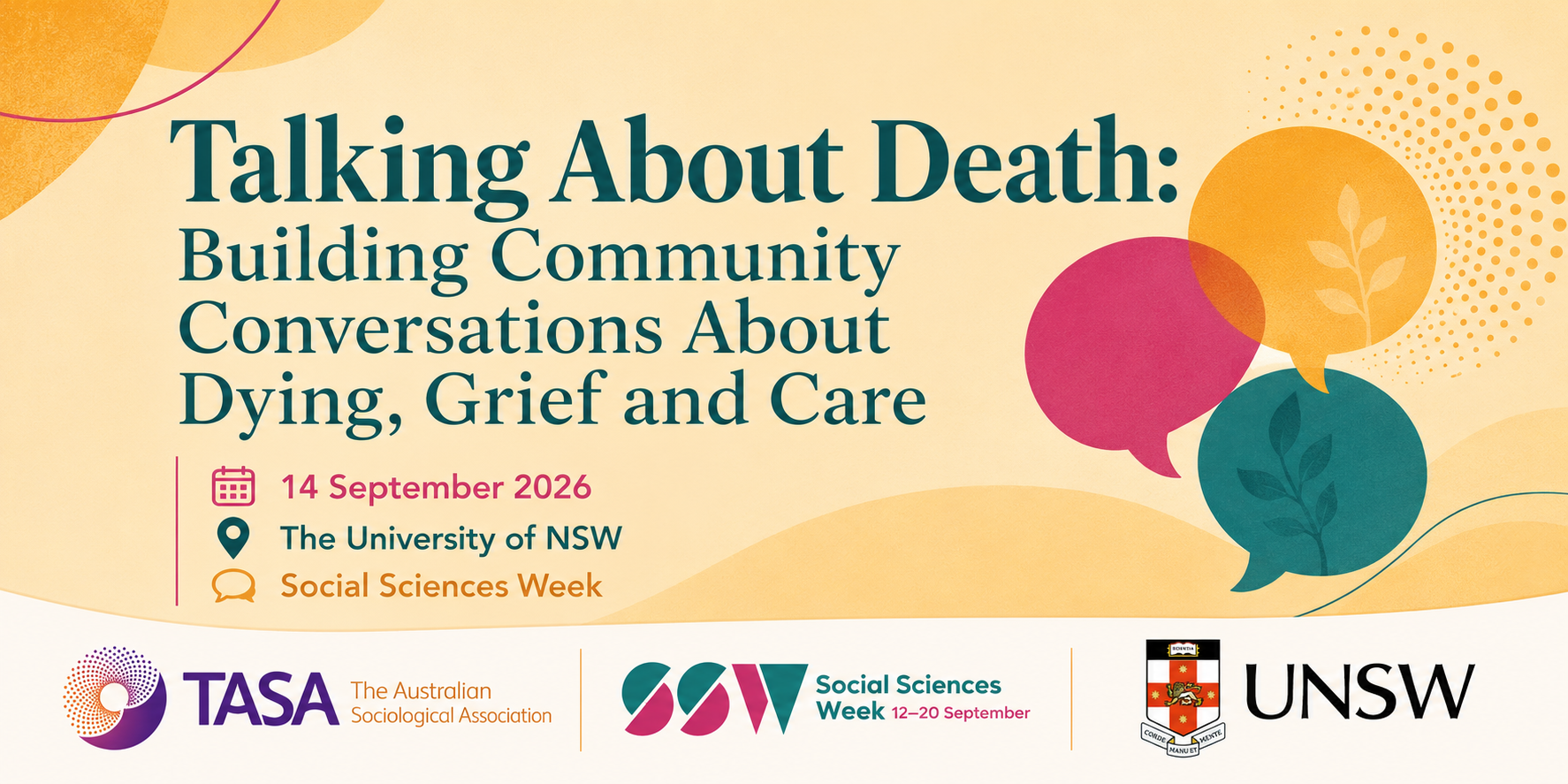 | The two-part event will comprise a panel discussion followed by facilitated round-table conversations inspired by the Death Café model
September 14, 4:00pm - 6:00pm (AEST)
UNSW Scientia Galleries, John Niland Scientia Building (G19)
The event is being hosted by the UNSW School of Social Sciences in collaboration with TASA via Giselle Newton, the Public Sociology portfolio leader.
The panel discussion will be facilitated by fellow member Emma Kirby (Lead of The Care Lab at UNSW)
Panellists:
- Fellow member Na'ama Carlin (Co-author of Being Patient: Close Encounters in Cancer World)
- Louise Chappell (Co-author of Being Patient: Close Encounters in a Cancer World)
- Cindy Stocken (PhD candidate researching living wakes)
- Jodie Clarkson (palliative care outpatient in Mparntwe (Alice Springs). She has been living with brain cancer since 2017. Jodie is the consumer representative for the Palliative Care Northern Territory
- Victoria Spence, Founder and Director of Life Rites and mortality doula
Despite the inevitability of death and dying, they remain social taboos such that the silence around them leads people to be unprepared, feel isolated and afraid. These experiences compound for patients undergoing cancer treatment, who live with uncertainty.
| | Water & Words
There has been an increasing interest in how physical movement, like walking, can be used to think and write sociologically. However, what happens when swimming and writing are combined?
In this workshop hosted by the Wangaratta Masters Swim Club, up to twenty participants will get the opportunity to engage in a combined writing and swimming class to explore, through words, their love of the water, what inspires them to swim, and the meaning swimming has in their everyday and social lives.
| | | | Annual Sexualities and Genders Research Showcase
To celebrate Social Sciences Week 2026, you are invited to the Annual Sexualities and Genders Research Showcase - hosted by Western Sydney University's Sexualities and Genders Research Group (SaGR) in the School of Social Sciences, and the Institute for Culture and Society's Queer Cultures Research Program.
Wednesday 16 September 2pm - 5pm, Western Sydney University
| | | Social Cohesion Symposium: Belonging, Resilience, and Democratic Participation
September 14 at 9:30 am - 4:00 pm AEST, Sydney
Speakers include fellow members Adam Possamai and Alphia Possamai-Inesedy
Join leading researchers, educators and community voices at this thought-provoking event that explores some of the most pressing challenges facing contemporary Australia, from multiculturalism and social cohesion to media trust, democratic participation, belonging and resilience. Through expert panels and lively discussion, the symposium will examine how communities navigate exclusion, build connection, and contribute to a more inclusive society.
| Our Stories: Make a Film with Your Community
Wednesday 16 September 5:00pm - 7:00pm AEST
The University of Sydney
Supported by TASA's SSW funding program
Our Stories invites community members and anyone interested in storytelling to explore how people represent their experiences and places through film. The evening features a short talk by fellow member Habib Moghimi and Nick Grinpukel on how documentary and creative media can support communities in telling their own stories. The session asks: who tells our stories, who decides what is seen and heard, and what changes when people hold the camera themselves?
|
Join us for a special TASA Thursdays: New Members’ Onboarding Session at 12.30pm on Thursday 17 September. This event is designed to welcome and connect new members to The Australian Sociological Association.
Hosted by the Student Career Stage Group Convenors and TASA staff, this session will introduce members to TASA, reflect on sociology in Australia today, and highlight the events, networks, thematic groups, career stage communities, journal access, newsletter, and professional development opportunities available. Attendees will be guided through TASAweb and shown how to get involved, access key resources, and make the most of their membership. Questions are warmly encouraged. All are welcome.
With Joelle Moore, Brooklyn Donnelly, Gene Khyle Francis Galvez, Sally Daly, Penny Toth and Ali Smith.
| |
Book Chapters
Journals
Julia Coffey, Steven Threadgold (2026) Beyond the social media minimum age act: Youth, algorithmic power and the data industry, Australian and New Zealand Journal of Public Health, Volume 50, Issue 5, https://doi.org/10.1016/j.anzjph.2026.100587 [open access].
Molnar, L., & McCook, S. (2026). “Everyone’s Moving, and Learning Together”: Young People and Practitioners Working with Collective Care to Create Futures Without Gender-Based Violence. Social Sciences, 15(8), 520. https://doi.org/10.3390/socsci15080520 [open access].
Higham, L., Mayes, E., Wolfe, M. J., & Finneran, R. (2026). Sonic atmospheres in and beyond urban alternative schools: The affective politics of sound, neurodiversity, and the ‘beautiful paradox’ of music. Children’s Geographies. https://doi.org/10.1080/14733285.2026.2720921 [open access].
Kantek, J., James, D., Arachchi, T. M., & Goggin, G. (2026). ‘Getting by with AI’: international students’ everyday use of Generative Artificial Intelligence as shadow care. Communication Research and Practice, 1–20. https://doi.org/10.1080/22041451.2026.2721183 [open access].
Atherton, S., Hanckel, B., Berriman, L., Moore, K., Suppers, J., (2026) 'Young People and Social Media Bans: The Need for a Youth Centred Approach', Youth and Policy, https://www.youthandpolicy.org/articles/young-people-and-social-media-bans/
[open access].
Ferguson, N., Farrugia, A., & Dwyer, R. (2026). Working the Boundaries of Care: A Narcofeminist Analysis of Alcohol Consumption Practices Among Nurses and Midwives in Australia. Contemporary Drug Problems, 00914509261460214. https://journals.sagepub.com/doi/10.1177/00914509261460214 [open access].
Ferguson, N., Ravn, S., & Craig, L. Between happy futures and precarious presents: The promise and pitfalls of work for single mothers on the margins in Australia. Critical Social Policy, 02610183261461223. https://doi.org/10.1177/02610183261461223 [open access].
Higham, L. (2026). Slow violences of normativity in teachers’ lives at school: Exploring affective dissonance and nonbelonging for queer teachers and teachers of colour. Pedagogy, Culture & Society. https://doi.org/10.1080/14681366.2026.2668658 [open access].
Op-ed / Commentary
| Call for Special Issue Proposals for 2028
Each year the Journal of Sociology editors invite expressions of interest from the international community of sociological scholars to guest edit a Special Issue (SI) of the journal. This year they particularly welcome proposals that bring a new spark to the core themes of sociology and advance conversations of discipline-wide relevance.
For the full details of the call, please visit TASAweb here.
Proposals deadline: September 14th, 2026.
| Journal of Sociology, 62 (2)
Issue 62:2 includes a Special Issue on 'Platform Labour in the Global South and Global North', curated by guest editors Lutfun Nahar Lata, Andrew Copolov, and Aditya Ray. This issue includes an Introduction article, six research articles and three book reviews, all centred on digital platform work as this has developed across different geographical locations. In addition to the Special Issue articles, this issue also features four standard articles that all focus on migrants and migration. As usual, in this newsletter you find the abstracts for all articles and a link to each article.
All articles are available here.
| | Last Friday, fellow member Jenny Chesters, convener of the Social Stratification Thematic Group, hosted a TASA-supported event on Perceptions and Indicators of Social Class in Australia.
The event was a great success, with terrific presentations that generated some very good discussion. We extend a warm thank you to Jenny for organising the event, and to everyone who presented and attended. You are helping keep sociology alive!
Images: Left – Mark Western; bottom left – Quentin Maire, Matthew Bunn & Sonia Martin; bottom right – Charan Naidoo, Danielle Flack & Pedro Riquelme.
Immediately beneath the images is a recording of Steve Threadgold’s presentation. | | | 2026 Monthly ‘Catch Up & Write’ Sessions
Hosted by the Sociology of Youth Thematic Group
The Sociology of Youth thematic group are excited to continue hosting virtual ‘Catch Up & Write’ sessions on the last Monday of every month from 1:00pm to 3:30pm to ensure you all have a dedicated space to write and connect.
If you are interested in joining them, please refer to the below 2026 schedule to register for the sessions you would like to attend. While the writing group is hosted by the Sociology of Youth thematic group, they welcome other TASA members whose research engages with youth in interesting ways. The more the merrier!
2026 SCHEDULE: ‘CATCH UP & WRITE’ SESSIONS
Register to receive Zoom links + save the dates in your calendar!
ONLINE 1:00PM TO 3:30PM AEST
MONDAY 28 SEPTEMBER | REGISTER HERE*
MONDAY 26 OCTOBER | REGISTER HERE*
* Please note each month’s ‘Catch Up and Write’ session requires a separate registration as each session has a different Zoom link *
The Sociology of Youth team look forward to seeing you at an upcoming session!
If possible, please give the new TASA Sociology of Youth LinkedIn page a follow and share amongst your networks.
| How does research move beyond publication to create meaningful change? Join Ramón Spaaij, Mary Woessner, Ruth Jeanes and Simone Fullagar for this complimentary online seminar exploring the realities of research impact. Through practical examples from sport, gender equity, violence prevention and policy, the session will examine knowledge translation, stakeholder engagement and pathways to influence. Gain practical strategies for planning, demonstrating and sustaining research impact across grants, promotion, policy, practice, community engagement and opportunities.
REGISTER HERE
| | | | Transitions to Parenthood
Monash University and online
Friday, 23 October, 9:30 am – 5:30 pm
| | | | Engaging with Young People: Constructing, Conducting, and Translating Meaningful Research
Monday, 12 October 2026 from 9:30 AM to 4:00 PM (AEDT)
University of Sydney + Online
Free event (limited tickets available)
Some travel bursaries available
This workshop, co-hosted by the Sydney Centre for Healthy Societies and TASA's Sociology of Youth Thematic Group, will be a semi-structured space for researchers (HDR, early career, and established), industry practitioners, and young people to engage in critical conversations about the promise and complexities of youth-focused research. The workshop will also examine how youth research can be practiced in ethical and considered ways, and explore how to navigate its emotive and caring dimensions.
| | | Ready or Not?: Improving adoptability of regional, rural & remote preparedness research | 16 October 2026 | 9:30am - 1:30pm
Join the Remote, Regional & Rural Sociology thematic group, along with academics, professionals, students and community members for Ready or Not?: Improving adoptability of regional, rural & remote preparedness research, a half-day hybrid event exploring how research can better support regional, rural and remote Australia through challenging and disruptive futures. Hear from leading voices, take part in thoughtful discussions and build valuable connections across sectors. Attend online for free or In person
REGISTER HERE
| | | Leaving Religion and the Politics of Nonreligion
This symposium, hosted by the Sociology of Religion thematic group & held alongside the 50th anniversary of Religious Studies at the University of Sydney, invites researchers to explore nonreligion as a subject in its own right. Papers are invited on themes including deconversion, religious trauma and recovery, ex-member communities, post-religious life, the politics of nonreligion, the “Mark No Religion” campaign, and the complexities of measuring nonreligion.
University of Sydney, Friday 23 October, hybrid.
| | | | Theorising migration, settlement and diversity in unsettled times
Symposium Keynote: fellow member Amanda Wise
TASA’s Migration, Ethnicity and Multiculturalism and Social Theory Thematic Groups invite submissions for a half-day symposium exploring the theoretical foundations, current developments and future directions of migration, ethnicity and multiculturalism research.
23 November, University of the Sunshine Coast.
| | | Health Sociology Review, Volume 35, Number 2 (July, 2026).
All articles in the latest issue are available here.
| New: Lecturer
Level B sociologist, 3-year fixed-term basis
Australian National University (ANU)
ANU seek applicants with a demonstrated capacity to contribute to one or more of the following areas: global sociology; postcolonial studies and/or sociology of ethnicity; sociology of inequalities, economy and/or development; public sociology; social research methods.
| PhD Scholarship Opportunities
| New: Legal needs, access to justice and intersecting inequalities
Institute for Culture and Society, Western Sydney University with Law and Justice Foundation of NSW
This PhD project aims to contribute theoretical and applied knowledge to better understand inequalities in people’s experiences of legal problems and the opportunities for meaningful reforms that address intersectional disadvantages. There is flexibility as to the precise focus of the PhD thesis. The proposed project should align with the aims of the two partners, but can focus on a particular affected population, type of legal issue, experience of legal need, specific context, aspect of the legal assistance sector’s work or other relevant topic of interest. Tax-free stipend of $45,188 per year.
Working with fellow member Dr Catherine Hastings (incoming TASA Secretary) and Dr Kate Davies (L&J Foundation)
Application deadline: 31 October. Read on...
New: Placemaking through events: How Gather Round transforms urban and regional places (SRTSR0421)
Adelaide University
This PhD project will explore how the AFL’s Gather Round, a Festival of Footy, is shaping urban and regional South Australia. Moving beyond sport, Gather Round brings together communities, cultures and places across metropolitan, suburban and regional locations, creating opportunities for social, cultural and place-based value. The project will investigate how these impacts are created and experienced.
Expressions of interest deadline: 30 September. Read on... (also available via a URL address via the code SRTSR0421).
Border Security: Managing a Shared Responsibility Approach to Biosecurity at the Frontline
School of Humanities and Social Sciences, University of Tasmania
This PhD project will investigate how those working in border biosecurity – at ports and airports – interpret their roles, responsibilities, and everyday practices. This includes investigating how border biosecurity personnel understand their role as part of a shared responsibility approach, the ways in which they work with and collaborate with others, the forms of expertise, skill, and judgement used in making decisions, the challenges they face as part of their role, and how they navigate, work with or work around these to reach outcomes that are judged to be legitimate and credible.
Working with fellow member Professor Vaughan Higgins.
| Other Events, News & Opportunities
| New: Project invitation - Wellbeing of Baby boomer women living with disability in retirement/ semi-retirement
Were you born between 1946 to 1964, live in Tasmania or Victoria, and identify as a woman living with disability, chronic pain, or a mental health condition acquired before retirement? If so, we would like to hear your experiences in a confidential interview. To find out more and get involved, contact Peta.Cook@utas.edu.au for an information package. This study has been approved by the University of Tasmania Human Research Ethics Committee (HREC) Number H40747.
| | | New: Call for Fellowship Nominations
Academy of the Social Sciences in Australia
The Academy Fellowship currently comprises around 750 Fellows, of whom 38% are women, and 15 identify as Aboriginal or Torres Strait Islander.
Fellows of the Academy include Australia’s leading researchers and practitioners across the breadth of social science disciplines, as well as a number of honorary Fellows (those who have made significant contributions to the social sciences beyond research), and overseas Fellows working outside of Australia.
To become a Fellow of the Academy individuals must be nominated by three existing Fellows (a proposer and two seconders), and have demonstrated an outstanding contribution to one or more fields of social science research or practice in Australia. Nominations are considered by the Academy’s disciplinary Panels, by independent assessors, then by the Membership Committee before being put to a vote of Academy Fellows in a general ballot.
| Calling for a Sociological Perspective
| To Stay or Not to Stay: Why is that the question? - Student Journalist looking for a sociologist.
A call for TASA members to assist:
A student reporter at the University of Notre Dame Australia would like to interview a sociologist about the social dynamics of relationships that feel unfulfilling, how dating freedom in this day and age can still feel limiting, and why people may, generally speaking, remain in relationships they are not happy in.
The student aims to post the article on their digital portfolio and pitch it to specific media organisations.
For additional details, and to connect with the student, please email Sally in TASA Admin: admin@tasa.org.au
| Early Career Scholars Competition 2026
The Research Committee on Sociology of Health (RC15) of the International Sociological Association in collaboration with Dr Gabriela Irrazábal (RMIT Europe) and Dr Ignat Bogdan (Research Institute for Healthcare Organization and Medical Management of Moscow Healthcare Department) invites current PhD students and researchers who obtained their doctoral degrees within the three years prior to the submission deadline and work in the field of sociology of health to submit individual papers (4,000–6,000 words, English, APA 7th edition) on any topic within the sociology of health. The six highest-ranked papers will be presented at the XXI ISA World Congress of Sociology in Gwangju, Korea (4–10 July 2027); the three top-ranked papers will additionally receive RC15 membership for four years (if applicable) and full coverage of the congress registration fee.
People Places Prize
Future Leaders
Prize $10,000
The People Places Prize 2026 is about creative and innovative ideas for living places. The Prize is open to Australian citizens and residents aged 18 and over. The winner will receive $10,000 and their ideas featured on www.peopleplaces.org.au.
Creative and innovative ideas for the Prize can be in any (or combination) of four areas.
– The Arts
– Green spaces
– Building design
– Disability access
Entry deadline: 1 November. Read on...
|  | Award for Excellence in Research
The ISA Award for Excellence in Research and Practice is granted by the International Sociological Association to a sociologist whose outstanding contributions advance and promote sociological knowledge and practice, while strengthening the discipline, the profession, and the ISA.
| Kohli Fellowship 2027
Berlin Social Science Center
The Kohli Fellowship is awarded to a promising early-stage researcher in sociology. The fellowship is awarded for 24 months. The current monthly stipend is € 2,700, subject to revision.
Application deadline: 20 September. Read on...
| Summits
Australian Social Cohesion
5-6 November, Melbourne
The summit will explore the forces shaping Australia’s social fabric through the theme: Understanding Australia’s Social Fabric: Diversity, Connections, and the Future of Social Cohesion.
Seminars
ANU School of Sociology Seminar Series
The program for the ANU School of Sociology Seminar Series is now online. All seminars are hybrid, with options to join via Zoom. Please visit the School’s Humanitix page, here, to view and register for upcoming seminars.
Newcastle Youth Studies Centre (NYSC) 2026 Online Seminar Series
The full 2026 program for the Newcastle Youth Studies Centre’s online seminar series is now out (see below), you can check out each seminar, and register for them, at the NYSC Eventbrite page here.
Note, you can watch the full 2025 recordings at the NYSC's YouTube playlist here
|  | Conferences
Global Sociology in Turbulent Times
International Sociological Association
XXI ISA World Congress of Sociology
4 to 10 July 2027, Gwangju, Korea
The deadline for Integrative Sessions is 28 September. Integrative Sessions are semi-plenaries that engage a debate on the Congress theme. Read on...
The Modern Dream of Control: Uncertainty, Risk, and the Incalculable in Contemporary Society
WG04 Sociology of Risk and Uncertainty
Santiago, Chile / 20–22 January 2027 / UC-Chile, Lo Contador Campus
Holding this conference in Chile is an invitation to think about risk and uncertainty from a Global South perspective long accustomed to precarity, and to ask whether the paradigm of control that shaped modernity can, or should, be rethought altogether.
Abstract submission deadline: 20 September. Read on...
Towards a post-sustainability society? New challenges, agendas, and roles in socio-ecological transformation and its research
16-18 March 2027, TU Dortmund University, Germany
Abstract submission deadline: 15 November. Read on....
Schooling and Sexualities 4: 30 Years On
Australian Association for Research in Education
It will be primarily an in-person conference with some options for online attendance.
This event is being organised by fellow member Barrie Shannon.
30 Sep - 1 Oct
Adelaide University
Freedom and Hope in the Current Global Context
British Sociological Association
31 March-2 April 2027
University of Manchester, UK
Abstract submission deadline: 11 September. Read on...
| Call for the next Editor of International Sociology Reviews
The International Sociological Association currently has open a call for the next editor of International Sociology Reviews, one of ISA publications. Please consider the call yourself and share it, using link below, among your networks, and if you know people who would be good at the role, do encourage them to apply. It would be terrific to have a TASA member as the editor!
Expression of interest deadline: 10 September. Read on...
Call for Submissions - Special Issues
Epistemic Emotions in and around the law
Frontiers in Sociology of Law
Editors: Renata Grossi, Eve Hanan, Alessandra Minissale, Cecilia Nordquist, Kate Rossmanith.
Law and Emotion scholars have consistently challenged the reason versus emotion divide in our understandings of law and legal processes, scholars have established that emotion in law is methodologically sound, and epistemically significant. More recently an additional tool has emerged to further such investigations: epistemic emotions.
Abstract submission deadline: 5 November. Read on....
Rethinking Gender Pressures, Education and Wellbeing in Schools
Guest Editors: Associate Professor Garth Stahl (The University of Queensland), Dr. Sarah McDonald (Adelaide University), Dr. Rohann Irving (Flinders University), Professor Murray Drummond (Flinders University)
Gender is a fundamental dimension of child and adolescent development, and growing research highlights the influence of gender norms, expectations, and stereotypes on student wellbeing. Across school, family, peer, and digital contexts, young people encounter gendered pressures that shape their bculine and feminine ideals, gender based harassment, and internalised gender role stress are associated with elevated rates of anxiety, depression, self-harm, eating disorders, and suicidal ideation.
Manuscript submission deadline: 31 January, 2027. Read on...
Health security and health and care workforce resilience conflicts, crises and capacities
Health Policy, Elsevier, published in collaboration with the European Observatory on Health Systems and Policies
Guest editors: Ellen Kuhlmann, Katarzyna Dubas-Jakóbczyk, Michelle Falkenbach, Gabriela Lotta
Health security depends on a resilient health and care workforce. Yet climate change, pandemics, hybrid and armed conflicts, migration and rapidly evolving digital technologies are converging with a severe health and care workforce crisis, exposing major gaps in current health security policies. This special issue explores how health and care workforce resilience can become a cornerstone of health security through stronger governance, leadership, implementation and transsectoral policies. We welcome contributions covering all areas of the health and care workforce addressing health security challenges in single or multiple countries, primarily high-income countries in line with the journal’s scope.
Submission deadline: 31 January 2027 (acceptance to online publication: two days). Read on...
| For membership information, processes, and frequently used resources, visit the Members' Navigator. To contact a member of the team directly, see our TASA Staff page.
| Admin (Sally): admin@tasa.org.au
Events (Penny): events@tasa.org.au
Membership (Ali): membership@tasa.org.au
Indigenous (Morgan): indigenoussociology@tasa.org.au
Digital Publications Editor (Roger): digitalpe@tasa.org.au
Thematic Groups (Molly): thematicgroups@tasa.org.au
Postgraduates (Brooklyn): postgraduates@tasa.org.au | |